The Red Army invaded Hungary in late 1944 and early 1945, expelling the last of the German forces by 4 April 1945. Soviet war memorials sprang up almost immediately. Three in central Budapest alone – at Szabadság tér, Gellért tér and Vigadó tér – were inaugurated as early as 1 May 1945.
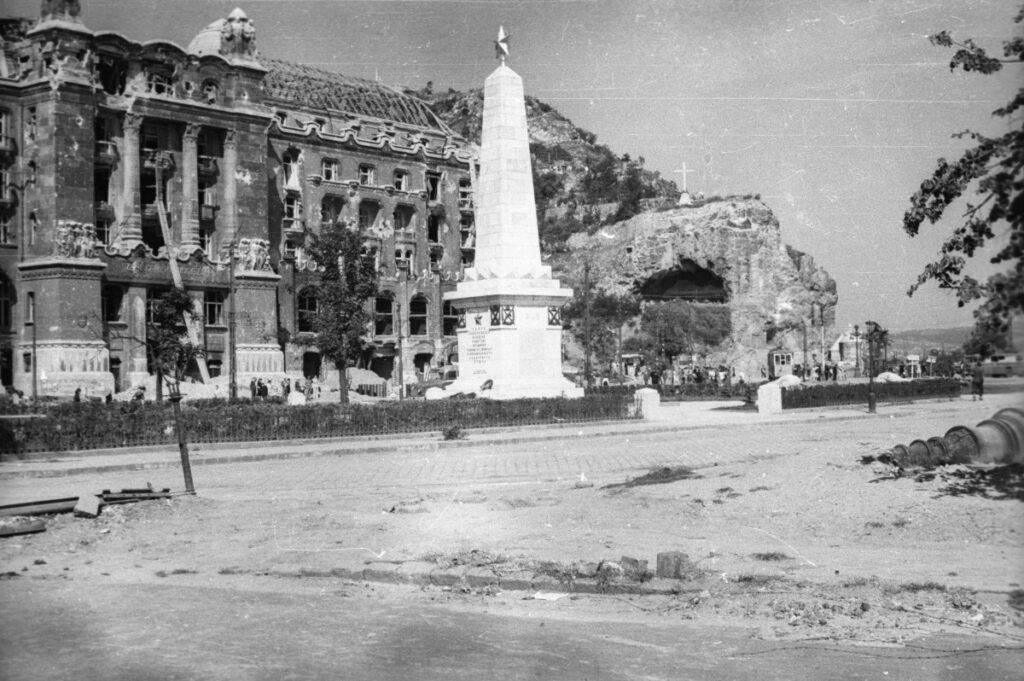
One striking feature is that the Soviets built the memorials when the surrounding buildings were still heavily damaged from the Battle of Budapest.
Szabadság tér
The main one – and the only one still in place – is in Szabadság tér in the northern part of District V.
There are two large bronze reliefs on the monument. The south-facing one shows Red Army soldiers, a tank and a flag. It also includes the Klotild Palace – near Ferenciek tere – and the original Erzsébet Bridge (not the one you see now, which dates from the mid-1960s). The north-facing relief features four Soviet figures including a nurse and a wounded man. Parliament is also visible. The Soviet crest in gold is still there on both sides. A gold five-pointed communist star sits atop it. The main text reads ‘Glory to the liberating Soviet heroes’ in Russian (on top, of course) and in Hungarian.
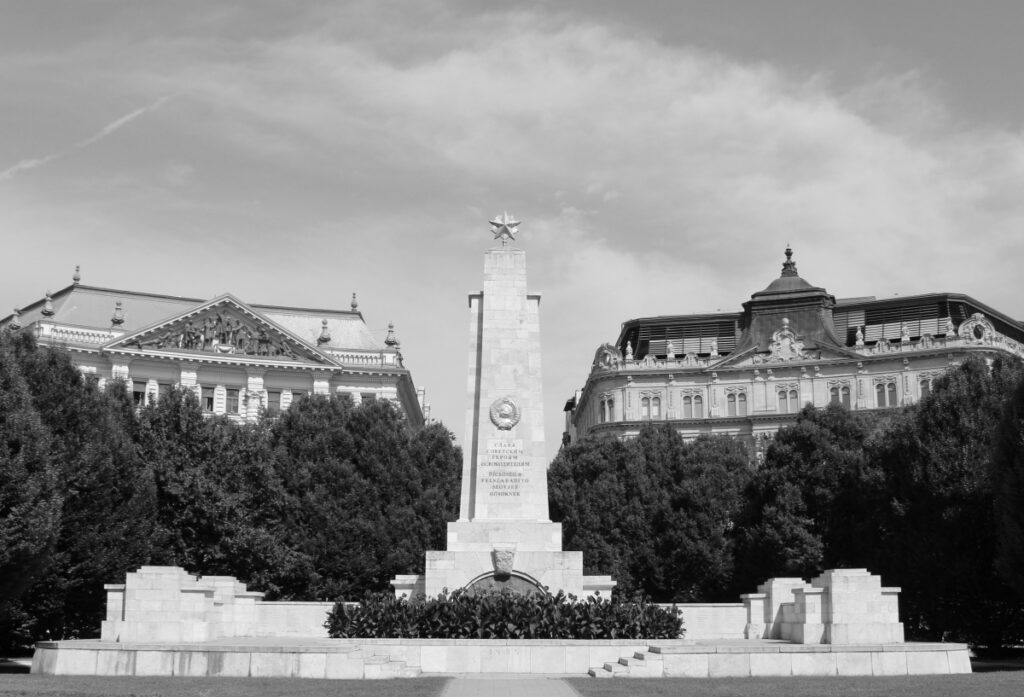
Marking their territory
This had previously been the location of a monument commemorating Hungary’s losses in 1920’s Treaty of Trianon. The peace diktat imposed by the Allies – at French behest – following the First World War cost Hungary one-third of its ethnic Hungarian population and two-thirds of its territory. This monument was still in place when the Soviet War Memorial was inaugurated but was soon removed and later destroyed. Under the communists, the Hungarian sense of loss stemming from Trianon was not politically correct.
The Szabadság tér memorial is right outside the US embassy, a fact that must have been in the minds of the Soviets when they decided on its location.
Like the other war memorials, protesters damaged it during the 1956 Uprising. Whatever the feelings of Hungarians towards the Red Army, there’s no chance of this monument joining the other communist relics in Memento Park. A treaty between Russia and Hungary means it will stay right where it is.
Memorial to Soviet Airmen
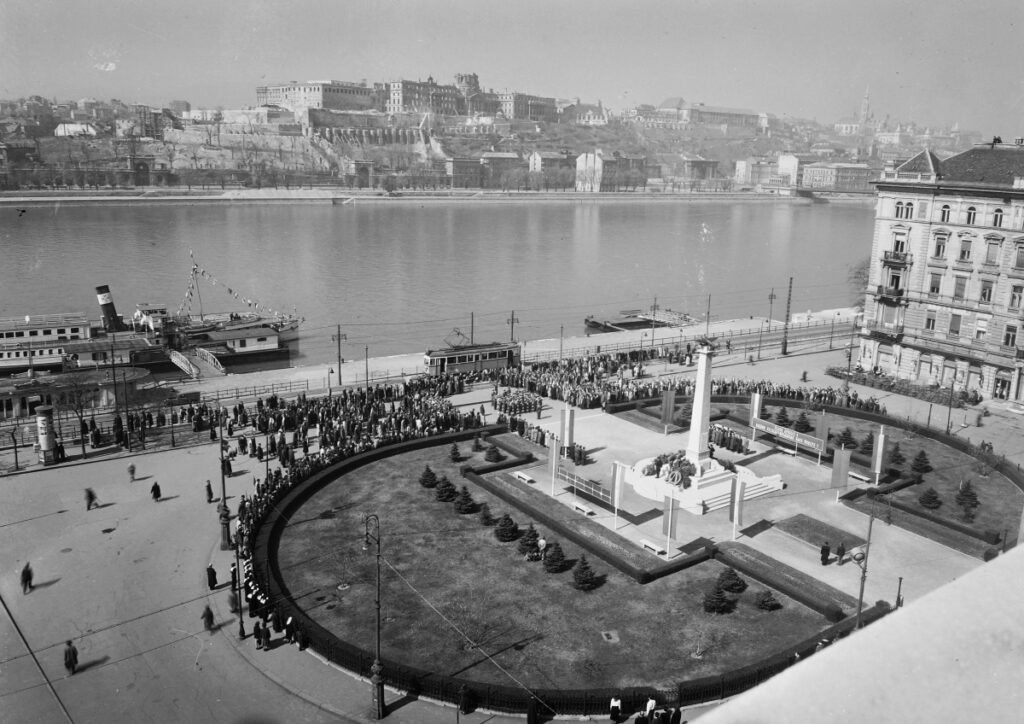
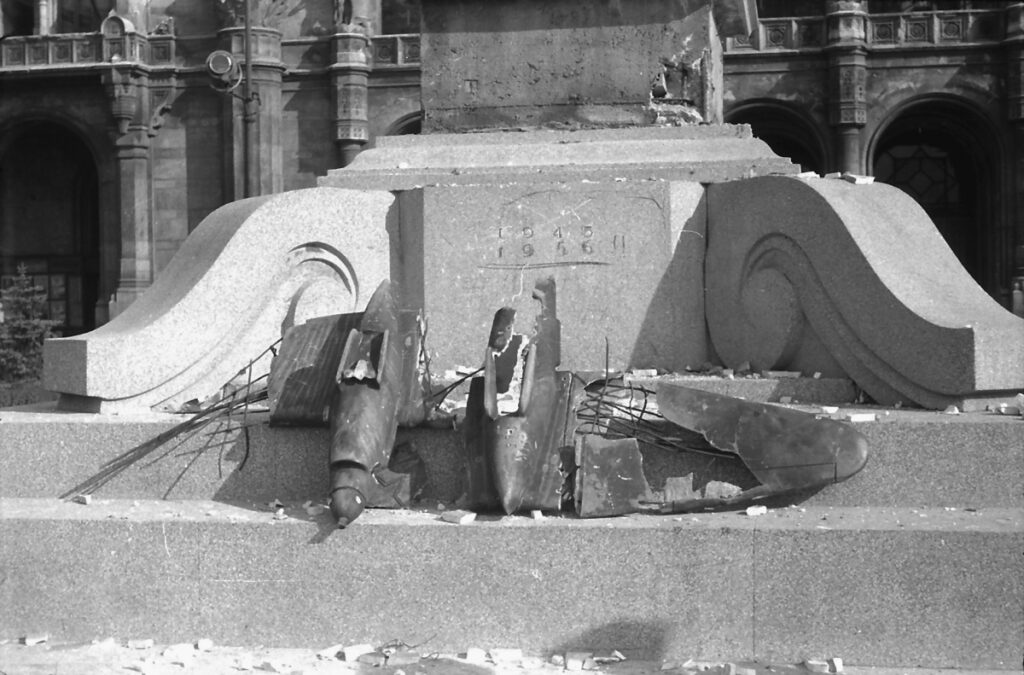
District V was also home to the Monument to Soviet Airmen. It stood in Molotov tér – today’s Vigadó tér. It featured a plane on top until anti-Soviet protesters vandalised it in 1956 after which it had a communist star. In 1975, a red granite obelisk replaced the original memorial. The obelisk is no longer there. You can now see it in the Soviet military plot in Kerepesi Cemetery. And the square where it stood once again bears its original name.
Gellért tér
The third of the Soviet war memorial trio stood in front of the Hotel Gellért on the Buda bank of the Danube. Its inscription read ‘Eternal glory to the heroes who fell in the fight for the freedom and independence of the Soviet Union and for the liberation of the Hungarian people’. It was situated approximately where the stairs descend to the Gellért tér-Műegyetem metro station. Locals daubed it with the slogan ‘Russians go home!’ (Ruszkik haza!) in 1956. It was only in 1991 – 35 years later – that their wish finally came true.
You can read more about the Soviet war memorials and over 100 other communist-era sights in Communist Budapest: The Guidebook. The book includes fact boxes on the historical context and on everyday life, custom-drawn maps and a timeline.


